
Global Times: China’s Long March rockets carry forward historic grit for new space exploration
Oct 29, 2026
Beijing, China, October 29, 2026 -- Footage released Sunday by the China Manned Space Agency captures astronauts conducting research and daily work aboard China's Tiangong space station, including a rice-growing trial aiming for a harvest in orbit. Behind these orbital achievements lies the enduring Long March spirit. Borrowing its name from the Red Army's epic expedition, China's Long March rocket series embodies that pioneering grit, carrying space hardware into orbit while pushing forward reusable rocket innovation.
These scenes reflect how far China's space capabilities have developed, from crewed flight to a space station in orbit and efforts to master reusable rockets.
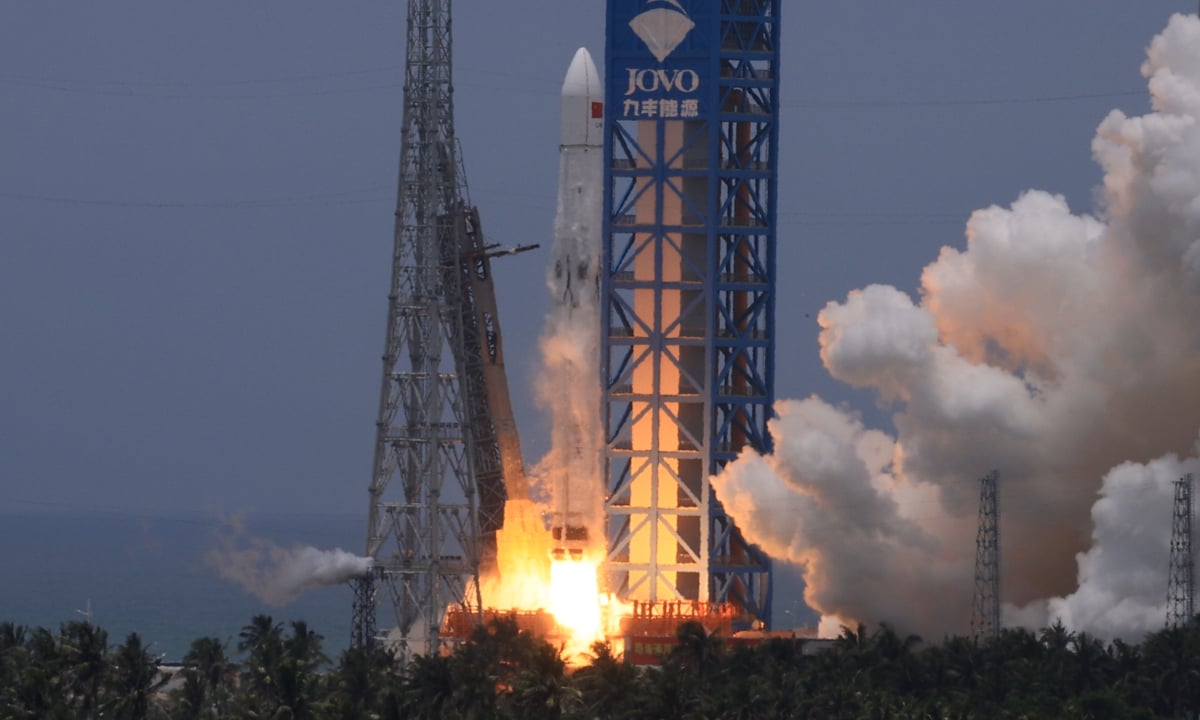
The name has become one of the most recognizable in Chinese aerospace sector, supporting crewed missions, launching BeiDou navigation satellite constellations, lunar and Mars exploration, and space station construction, Wang Yanan, editor-in-chief of Beijing-based Aerospace Knowledge magazine, told the Global Times on Sunday. Decades of development and successive breakthroughs have made the rocket program itself a technological Long March spanning generations, he said.
A Long March into space
The year 2026 marks the 90th anniversary of the victory of the Long March, the epic military trek from 1934 to 1936 that broke through the encirclement of Kuomintang forces. Some participants marched as far as 12,500 kilometers, helping lay the foundation for the eventual victory of the Chinese revolution, according to the Xinhua News Agency.
The rockets bearing its name reached another milestone on October 10, when a Long March-12 placed the 27th batch of low-Earth orbit internet satellites into their planned orbit. It was the Long March family's 671st launch, Xinhua reported. The first came on April 24, 1970, when a Long March-1 rocket carried Dongfanghong-1, China's first artificial satellite, into space.
That first flight followed years of work under difficult conditions. China began developing the launcher in the 1960s to send Dongfanghong-1 into orbit, when its industrial base was weak and access to key technologies was tightly restricted from abroad, according to Xinhua.
"Naming the launch vehicle 'Long March' meant that, like the Red Army on the Long March, it would overcome every difficulty and ultimately achieve victory," Han Houjian, who worked on the Long March-1's overall design, recalled, according to Xinhua.
At a media briefing on September 21, Long Lehao, an academician of the Chinese Academy of Engineering and a launch vehicle expert at China Aerospace Science and Technology Corporation, traced the name to a proposal by pioneering Chinese scientist Qian Xuesen on May 31, 1966.
The name "Long March" conveyed the idea that developing China's launch vehicles was a new Long March toward the stars, Long said, quoting Qian. "Just as the Red Army had endured countless hardships on its 12,500-kilometer trek, China's rocket developers would have to overcome formidable obstacles, with the same conviction that their efforts would ultimately lead to success," he added.
Since the first launch, the family has progressed from carrying one satellite at a time to deploying 41 in a single mission. It has also expanded the range of spacecraft it can launch and advanced from expendable vehicles toward reusable designs, Long said.
These advances give the name a meaning beyond historical remembrance, Kang Guohua, a senior member of the Chinese Society of Astronautics and a professor of aerospace engineering at Nanjing University of Aeronautics and Astronautics, told the Global Times on Sunday. Just as the Red Army fought to break through encirclement, China's space program has repeatedly had to find a way through external restrictions, he said.
Kang cited the development of BeiDou and China's own space station as examples of breakthroughs achieved amid outside competition and technological barriers, while Long March rockets provided the means to carry that technological struggle forward. Naming the family after the Long March could hardly be more fitting, he added.
From smaller launchers to the powerful Long March-5, and from conventional propellants to cleaner alternatives, the family has continued to evolve. Its vehicles now meet launch needs in low and high Earth orbits and deep space, carrying satellites, crewed spacecraft and probes on missions that underpin China's pursuit of self-reliance in space technology, Xinhua reported.
The journey ahead
That pursuit continues as China prepares for a more demanding phase of space development. The Long March rockets of today already differ greatly from those of decades ago, Wang said. Future versions will need to be larger and more capable, supporting more frequent launches, heavier payloads and a more sustainable launch program.
Wang drew a parallel with the historical Long March: reaching northern Shaanxi did not mark the end of the Chinese revolution, and the rocket family's achievements are likewise milestones along a continuing journey. Earlier breakthroughs opened a new chapter, he said, but the space program now faces fresh challenges as its goals grow more ambitious and the demands on its launch vehicles increase.
Two missions this year show how the next stage is taking shape. On June 1, a Long March-12B made its maiden flight from a commercial launch pad in the Dongfeng Commercial Aerospace Innovation Pilot Zone, delivering the 10th constellation of Qianfan satellites into orbit.
Designed to serve commercial demand, including the deployment of large internet constellations, the reusable rocket has a single core stage about four meters in diameter and can carry out missions to different orbits. Its development emphasizes performance, safety, efficiency and lower costs, according to Science and Technology Daily, a Chinese media that focused on technology.
A further milestone followed on July 10, when a Long March 10B carrier rocket lifted off from the Hainan commercial space launch site, successfully placing its satellite payload into the designated orbit and completing its maiden flight mission.
Approximately six minutes after the separation of the rocket's first and second stages, the first stage made a controlled vertical descent and was successfully recovered through a net-based capture system on an offshore recovery platform located more than 300 kilometers away from the launch site. The first-stage recovery mission was completed successfully.
The mission marked China's first successful controlled recovery of a launch vehicle's first stage and also the world's first net-based recovery of a launch vehicle. The Long March 10B carrier rocket has become China's first reusable launch vehicle to successfully complete a recovery mission.
Like the historic Long March, China's rocket program has broken through external barriers and achieved important victories, Wang said, adding that as of now, greater ambitions now bring fresh challenges: China's expanding plans in space require more frequent launches, greater payload capacity and a more sustainable launch program, placing new demands on the Long March family - developing reusable, heavier and more advanced models.
The Long March into space is not only a journey for China. "Reaching orbit is only stage one in humanity's exploration of space, our journey will continue to other planets and deeper into the universe," Wang said, "and that journey will also be a Long March for all humanity."
This article first appeared in the Global Times:
https://www.globaltimes.cn/page/202610/1372503.shtml
Contact Info:
Name: Anna
Email: Send Email
Organization: Global Times
Website: https://www.globaltimes.cn/
Release ID: 89207788
Should you detect any errors, issues, or discrepancies with the content contained within this press release, or if you need assistance with a press release takedown, we kindly request that you inform us immediately by contacting [email protected] (it is important to note that this email is the authorized channel for such matters, sending multiple emails to multiple addresses does not necessarily help expedite your request). Our expert team will be available to promptly respond and take necessary steps within the next 8 hours to resolve any identified issues or guide you through the removal process. We value the trust placed in us by our readers and remain dedicated to providing accurate and reliable information.
More News

DBM chief urges public to monitor public funds via 'COMPASS' spending tracking platform
Department of Budget and Management (DBM) Secretary Kim Robert De Leon urged the public to use the government's unified budget transparency platform to monitor how public funds are released and spent, and to ensure that the institutions managing them are held accountable.

Sandiganbayan drops Samchan exec as co-accused in Martin Romualdez plunder case
The Sandiganbayan Third Division has removed a businessman as a co-accused in the plunder case against former House speaker Ferdinand Martin Romualdez, clearing the way for the former to testify for the prosecution.

Health groups want total ban on vapes, cigarettes
Public health groups have called for a comprehensive ban on tobacco and vape products after a joint survey by the Department of Health (DOH) and an advocacy group found that Filipino children as young as 7 have started smoking or vaping. The 2024 Global Youth Tobacco Survey released by the DOH and the Positive Youth

SC reverses cyberlibel ruling vs Quezon businesswoman
The Supreme Court has acquitted of cyberlibel an individual who posted on social media the alleged extortion attempt of a town mayor in Quezon province when her family sought permits for a planned fast-food chain business. The high court, in a 16-page ruling in January, released on Friday, reversed the conviction of Jade Karla Tan

Baligod, group ordered arrested for cyberlibel
A court in Lanao del Sur has ordered the arrest of lawyer Levito Baligod and the 18 witnesses under his watch for cyberlibel charges filed by a lawmaker. According to the arrest warrant issued by Presiding Judge Samina Sampaco Macabando-Usman of Branch 8 of the Marawi City Regional Trial Court, bail was set at P30,000

PNP gets P3B more; judiciary, El NiÑo budgets found lacking
The Philippine National Police stands to gain nearly P3 billion in additional funding next year, even as the agriculture sector and the judiciary are left pleading to at least retain their proposed allocations, it was learned on Friday. The PNP was allotted an additional P2.913 billion for 2027, on top of its proposed P242.53-billion allocation,

‘Fire on the shore’: Church sets mass action on SC fisheries ruling
Cardinal Pablo Virgilio David on Friday urged the Supreme Court to reconsider two rulings that weaken protections for small-scale fisherfolk and called on Church communities and concerned citizens to join a rally at the high tribunal next week. In a pastoral statement titled “The Fire on the Shore,” David said on Friday the Dec. 3

‘Falling car’ probe: Building flaws or driving error?
Police are looking into the health condition of the man driving a car that fell from the parking area of a hotel building in Makati City on Thursday, as investigators continue to determine if there was negligence or criminal liability involved in the incident. In an interview on Friday, Lt. Margaret Panaga, public information officer

Luistro on next defense witness: Same banana?
Batangas Rep. Gerville Luistro on Friday reminded Vice President Sara Duterte and her defense lawyers that Cale88, a company registered as a banana chips maker and now under scrutiny in Duterte’s impeachment trial, is just one piece of the bigger puzzle regarding her alleged unexplained wealth. Luistro said she also expected the next testimonies to

Sara Duterte ‘prepared for worst’ as trial nears decision
Vice President Sara Duterte said on Friday that her office and staff would conduct business as usual if she were acquitted in her Senate impeachment trial, but she was also prepared “for the worst” in case she is convicted. Duterte is being tried for unexplained wealth, which allegedly amounts to at least P817 million and

House prosecutors ready to cross-examine Sara Duterte if she takes witness stand
The House prosecution panel is prepared to cross-examine Vice President Sara Duterte if she decides to take the witness stand in her Senate impeachment trial.

Anwar renews bid to keep Loke in cabinet, cites his ‘commendable’ performance
UPDATED 3.20PM | PM says duty to serve the people and country must take precedence.
YOUR NEWS, OUR NETWORK.
Do you have Great News you want to tell the world?
Be it updates about your business or your community, you can make sure that it’s heard by submitting your story to our network reaching hundreds of news sites across 6 verticals.