
As Japan Stops Subscribing, Newspapers Become a Minority Habit
Nov 1, 2026
Newspaper subscriptions have fallen below 50% for the first time in a nationwide survey. A high school student who finds news on social media and a 68-year-old man who still reads the paper each morning illustrate the changing place of journalism in Japanese life.
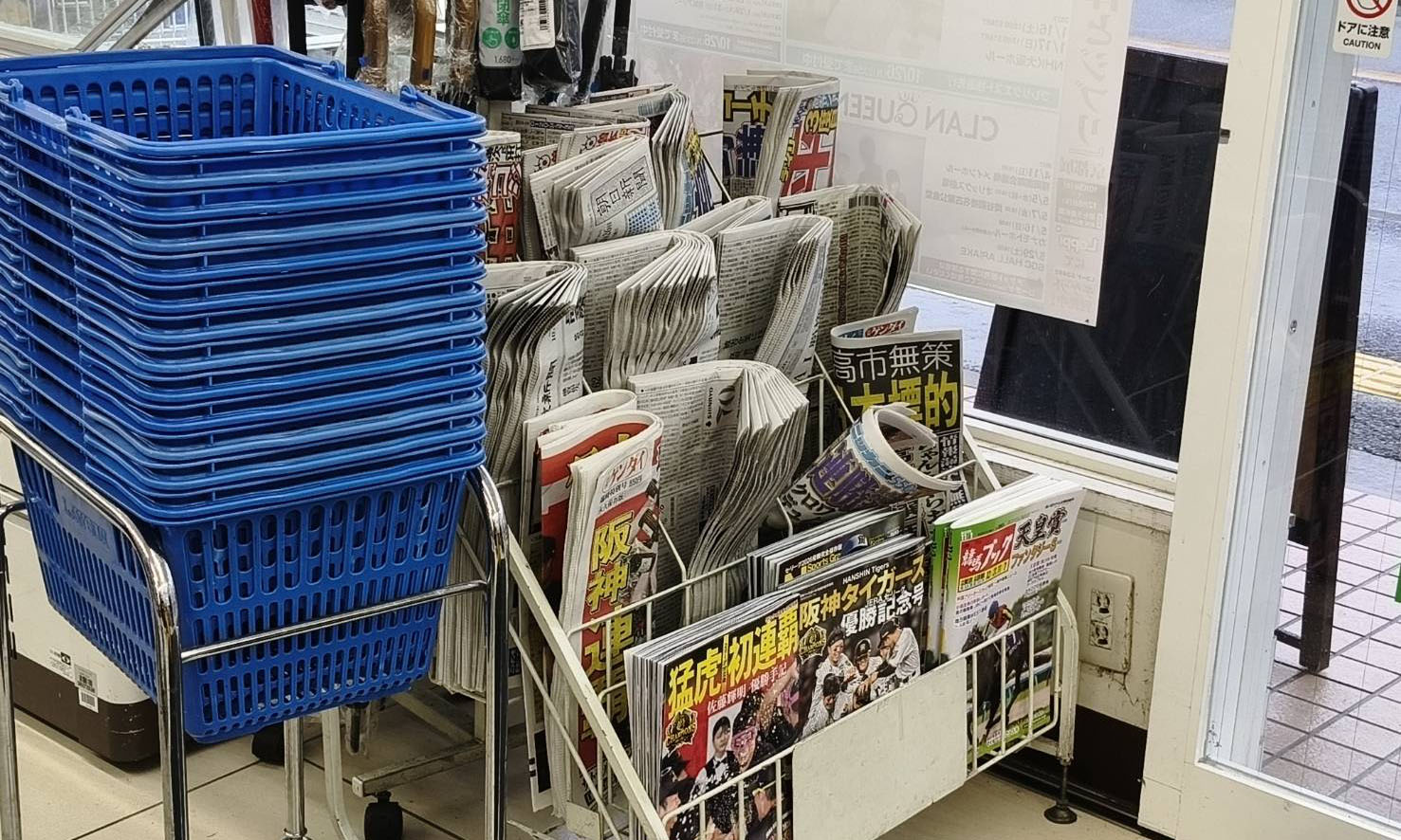
TOKYO, JAPAN (MERXWIRE) – For one Japanese high school student, keeping up with the news does not begin with opening a newspaper. “I don’t read newspapers. Before going out, I might watch a little of the news on television, but I more often find out what’s happening through social media,” the student said. “That’s usually what my friends and I are more likely to talk about, and I feel it’s closer to real life.” In that account, news is not simply a way to learn about public events. It is also a way to participate in conversations, with relevance shaped partly by what friends are discussing.
A 68-year-old man described a different routine, one in which the printed newspaper still has a place each morning. “We already have a newspaper subscription at home, and I’m very used to reading it every morning,” he said. “I watch television news as well, but with a newspaper I can read at my own pace, which I really like.” For him, newspapers and television are not competing alternatives. They offer different experiences, and the ability to control the pace of reading remains a reason to value print.
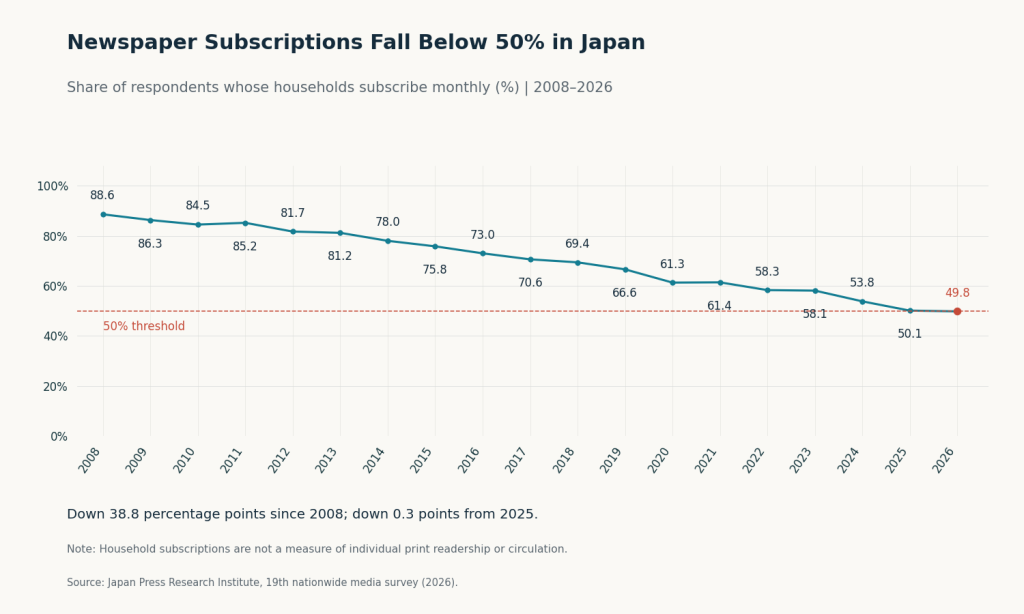
Neither interview represents an entire generation, but together they give a human dimension to a divide documented in a nationwide survey. According to the Japan Press Research Institute’s 19th annual survey on media, conducted in 2026, 49.8% of respondents said their household subscribed to a newspaper on a monthly basis. It was the first time the figure had fallen below half since the survey began in fiscal 2008, when it stood at 88.6%. Behind that decline is a changing calculation about subscriptions: Some readers stay because newspapers still fit their lives, while others see little need to begin paying for information they believe is already available elsewhere.
A Long Decline Crosses a Symbolic Threshold
The latest subscription figure was only slightly lower than the previous year’s 50.1%, a decline of 0.3 percentage points. Viewed in isolation, that is a modest annual change. Over the longer period, however, the share has fallen by 38.8 percentage points since fiscal 2008. Crossing below 50% does not mean the industry suddenly lost a large portion of its audience this year; rather, it marks a visible milestone in a retreat that has unfolded over many years.
Print readership has also declined. In the latest survey, 44.1% of respondents said they read a printed newspaper delivered through their household’s monthly subscription, while 43.6% said they did not read newspapers or newspaper articles. In fiscal 2018, those figures were 62.6% and 23.5%, respectively. The distinction between household subscriptions and individual reading matters: The 49.8% figure measures whether a respondent’s household subscribes, while the 44.1% figure measures whether the respondent personally reads that household’s printed paper. A newspaper can continue arriving at the door without becoming part of every household member’s day.
Younger Readers Have Different News Entrances
The high school student’s account is not one of complete disengagement from news. Television provides some information before leaving home, while social media supplies updates that are more likely to enter conversations with friends. The student’s description of those updates as “closer to real life” expresses a sense of personal relevance, not a demonstrated judgment that social media is more accurate than newspapers. The choice of a news source may depend not only on whom a person trusts, but also on whether its content connects with daily life and social relationships.
The survey shows a pronounced age divide. Among respondents in their 20s, 12.6% said they read a printed newspaper through their household’s monthly subscription, compared with 13.1% of those in their 30s, 23.7% of those in their 40s and 73.2% of those aged 70 or older. Meanwhile, 76.3% of respondents in their 20s and 71.1% of those in their 30s said they did not read newspapers or newspaper articles. Daily reading was rarer still: Just 2.1% of respondents in their 20s and 4.4% of those in their 30s read newspapers every day, compared with 64.9% of those aged 70 or older. Those findings cannot be applied directly to an individual high school student, but they highlight an important challenge: Some younger people are not abandoning a newspaper habit. They never developed one.
The Main Reason Not to Subscribe: Enough Information Elsewhere
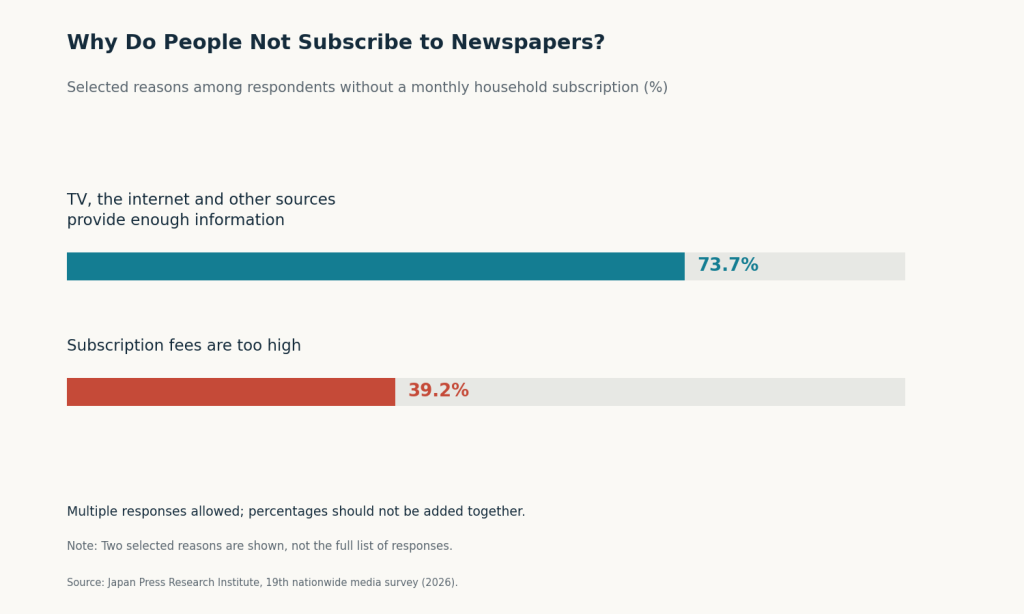
Among respondents whose households did not subscribe to a newspaper monthly, 73.7% said information from television, the internet and other sources was sufficient. The next most common reason was that subscriptions were too expensive, cited by 39.2%. Respondents could select more than one answer, meaning a person could regard a subscription as both costly and unnecessary. Together, the findings point to a problem that goes beyond price: If readers believe their information needs are already being met, publishers must explain what an additional monthly payment would provide.
Asked how they learned about major news, 70.4% of respondents cited commercial television, 64.9% the internet, 53.2% NHK television and 34.3% newspapers. Multiple answers were allowed, reflecting the range of sources that can coexist in a person’s news routine. Those sources also occupy different parts of the day: 19.3% of respondents reported encountering online news at work or school, and 17.9% while traveling on trains, buses or other transportation. Newspapers’ most common reading setting remained the home in the morning, cited by 34.8%. The competition is therefore not simply over which outlet has the best story, but over where news can fit into limited time and attention.
For Those Who Stay, Print Offers Its Own Pace
The 68-year-old reader does not see a need to choose between newspapers and television. What distinguishes the newspaper for him is the freedom to proceed at a familiar speed, making reading an activity he can control rather than a broadcast he must follow. His account echoes the survey’s findings among existing subscribers: About 47% cited an established reading habit as a reason for maintaining their subscription, making it the most commonly selected explanation. The value lies not only in the information delivered, but also in how reading fits into an established morning routine.
Habit is an asset for publishers because it allows a product to remain part of daily life without having to win the customer’s attention anew each morning. But it also has limits: What one generation does automatically may not become necessary to the next. The older reader values a pace he can set for himself; the student values material that connects with conversations among friends. Both are choosing ways of following news that fit their lives. For publishers, that suggests the challenge is not merely to move the same content onto another screen, but to give different audiences a reason to use it.
Trust Does Not Necessarily Lead to Payment
Interpreting the subscription decline simply as a collapse in public trust would miss one of the survey’s most striking findings. Asked to score the reliability of different media on a 100-point scale, respondents gave newspapers an average of 64.6, narrowly behind NHK television at 66.1 and ahead of commercial television at 59.8 and the internet at 46.9. Newspapers ranked first for reliability in each age group aged 39 or younger. Younger people, in other words, may regard newspapers as reliable without choosing to read or buy them. Trust, use and payment are separate decisions.
The survey also asked whether social media provided a better understanding of “the truth about society” than newspapers, television and other mass media. Overall, 22.8% agreed and 57.9% disagreed, a gap of 35.1 percentage points, while 18.2% said they did not know. Agreement was down 5.2 percentage points from the previous year. Younger respondents were more likely to agree, as were people who obtained political information exclusively from social media, compared with those who relied only on established media. Those differences show an association between information habits and attitudes; they do not establish that social media use itself caused the belief.
The student’s description of social media as closer to real life can be understood against that distinction. A platform can feel more relevant because it reflects friends’ discussions, personal interests or familiar experiences, without necessarily being judged more trustworthy. People do not have to reject newspapers’ credibility to stop reading them, just as they do not have to consider social media more reliable to open it every day. Maintaining trust remains important for publishers, but trust alone does not guarantee a subscription.
For 16.6%, Even Free Is Not Enough
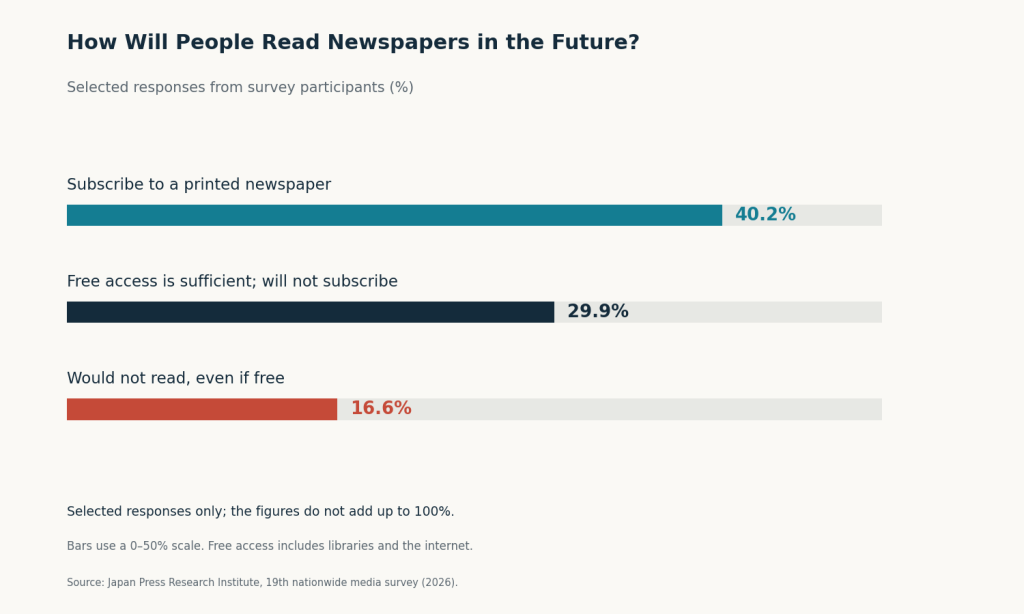
Asked how they expected to engage with newspapers in the future, 40.2% of respondents said they would subscribe to a printed paper, down from 58.5% in fiscal 2018. Another 29.9% said free access through libraries, the internet and other sources was sufficient and that they would not subscribe. A further 16.6% said they would not read newspapers even if they were free. These answers reveal different distances from the product, and different obstacles for publishers seeking to attract readers.
People who consider free access sufficient may still value newspaper content; they simply do not see a reason to pay regularly for it. For publishers, the challenge is to turn that use into a purchase. Those who would not read even at no cost present a different problem, one that a lower subscription price cannot resolve on its own. Among respondents aged 18 and 19, 44.4% chose that answer, as did roughly a quarter of respondents in both their 20s and 30s. Reaching those audiences may require establishing a reason to read before establishing a reason to buy.
Yet not reading newspapers does not necessarily mean ignoring current events. The high school student’s account is a reminder that newspapers can be absent while news continues to enter daily life through television and social media. The survey likewise found that the internet had the highest news reach in every age group aged 59 or younger. The alternative to a newspaper is therefore not a single replacement product, but a dispersed collection of entrances: television, websites, free articles and social platforms, none of which necessarily requires loyalty to one newspaper brand.
Digital Editions Have Not Automatically Replaced Print
For publishers, an obvious transition is to move print readers toward digital subscriptions. But a decline in paper does not mean an equivalent rise in paying online readers. In the question about how respondents read newspapers, 2.2% selected paid digital editions, up from 1.1% in fiscal 2018, while 6.4% said they read newspaper articles through internet portals and similar services. A separate question about paid online news services found that about 93% did not use them, while roughly 4% paid for digital newspapers or newspaper articles. The questions use different definitions and should not be treated as the same measure, but neither suggests that changing the delivery format automatically produces paying customers.
Digitization changes distribution; it does not, by itself, create willingness to pay. Even without printing and delivery, a newspaper must explain why its reporting is worth buying when free news is already on the reader’s screen. The survey and the two interviews suggest directions publishers could test, rather than proven solutions. For established readers, preserving a clear, complete experience that allows them to control the pace may matter alongside faster updates. For younger people who encounter news socially, the question is how to produce journalism they want to open, understand and discuss—not simply how to place a print headline on a digital platform.
Two News Routines, One Subscription Challenge
The survey describes respondents’ subscriptions and media habits, not a direct count of nationwide newspaper circulation, and it cannot establish the causes of every change it records. Nor can two interviews stand in for whole generations. But they offer a way to understand what the numbers mean in everyday life. For the 68-year-old man, the newspaper’s value includes the ability to read at his own pace each morning. For the high school student, news is more likely to arrive in material that can be shared and discussed with friends. The difference is not simply paper versus a screen, but how journalism becomes relevant.
Publishers are therefore trying to do more than move an existing audience from one format to another. They must preserve the value that keeps established readers returning while giving people without a reading habit a reason to begin. As a newspaper subscription becomes less of an automatic household expense, the next sale will depend less on yesterday’s routine—and more on a reason to pay today.
More News

Top Singapore law firm fined for data breach affecting 143,756 people
Singapore's data regulator has fined Rajah & Tann, one of the city-state's largest law firms, S$247,000 (US$191,000) over a 2023 breach in which the personal data of up to 143,756 people was stolen.

From 30pct to zero: Former exco, NGO lament current N Sembilan all-male exco team
Women's views deserve representation at decision-making level, Tan says.

Christmas 2026 on a budget: Here are 10 unisex gifts under P1,000
Looking for Christmas presents that are thoughtful, practical, and budget-friendly? You don't have to spend a fortune to make your loved ones feel special this holiday season.

Groups urge Congress to further increase education budget for 2027
MANILA, Philippines — A national coalition on Friday called on Congress to further increase the proposed government budget for education in 2027 as both chambers prepare for bicam. E-Net Philippines made the pronouncement after the Nov. 24 Senate plenary deliberations where senators called for increased funding for education. READ: Senate approves ₱915.4B DepEd budget for

Pia Cayetano flags risks of ‘flavored air,’ energy drinks to youth
MANILA, Philippines — Sen. Pia Cayetano on Friday raised concerns over the marketing of so-called “flavored air” products and highly caffeinated energy drinks, warning that these could pose health risks to young people. Cayetano raised the concerns during the Senate’s deliberations on the proposed 2027 budget of the Department of Health (DOH) and its attached

Sotto urges DICT to crack down on online sale of abortion drugs
MANILA, Philippines – Senate President Pro Tempore Vicente “Tito” Sotto III on Friday urged the Department of Information and Communications Technology (DICT) to crack down on social media pages or groups selling abortifacients and promoting abortion. Abortifacients are substances or drugs used to induce an abortion or terminate a pregnancy. “There are groups on Facebook

Nov. 27 lotto results: Lone bettor wins ₱44.2M jackpot
MANILA, Philippines—A lone bettor won the ₱44.2 million Mega Lotto 6/45 jackpot on Friday, Nov. 27, while no player won the ₱603.58 million Ultra Lotto 6/58 top prize. According to the Philippine Charity Sweepstakes Office (PCSO), the winning combination for Mega Lotto 6/45 was 33-37-36-26-23-03. READ: Lotto Results Today – November 27, 2026 Meanwhile, no

Legarda urges LGUs to set up free public cooling centers for El Niño
MANILA, Philippines — Sen. Loren Legarda is urging local government units (LGUs) to open free public cooling centers in barangay halls and other accessible community facilities, and partner with shopping malls to provide relief from dangerous heat as a very strong El Niño threatens the health of vulnerable Filipinos. The proposal forms the sixth point of

SPD says driver who fell from Makati building only a reliever
MANILA, Philippines — The 55-year-old driver who fell from a fourth floor parking building along Jimenez Street in Barangay San Lorenzo, Makati City was only a reliever the day of the incident, the Southern Police District (SPD) disclosed. SPD Public Information Officer PLt. Margaret Panaga said that the driver picked up the vehicle parked inside

Manila Water sets desludging schedule for a cleaner holiday season
MANILA, Philippines —Manila Water releases its December desludging schedule for selected barangays in the East Zone of Metro Manila and Rizal, helping households maintain properly functioning septic tanks during the holiday season. The water and wastewater service provider is encouraging customers in scheduled areas to avail of the service before their septic tanks reach full

VP Sara: “Painful small talk” with senators during Senate visit
MANILA, Philippines — Vice President Sara Duterte on Friday shared that she had a “painful small talk” with senators when she went to the Senate on Thursday, emphasizing that being two-faced is a politicians’ national sport. This was the response of Duterte when she was asked about her visit to the Senate for the plenary
Road closures in Manila on Saturday, Nov. 28
MANILA, Philippines — Several roads will be closed in the city of Manila starting Saturday evening, Nov. 28, ahead of a road running event.According to the Manila Public Information Office, the following roads will be closed from 9 p.m. onwards on Saturday due to the AIA Rock and Roll Series Manila on Sunday, Nov. 29:
YOUR NEWS, OUR NETWORK.
Do you have Great News you want to tell the world?
Be it updates about your business or your community, you can make sure that it’s heard by submitting your story to our network reaching hundreds of news sites across 6 verticals.